

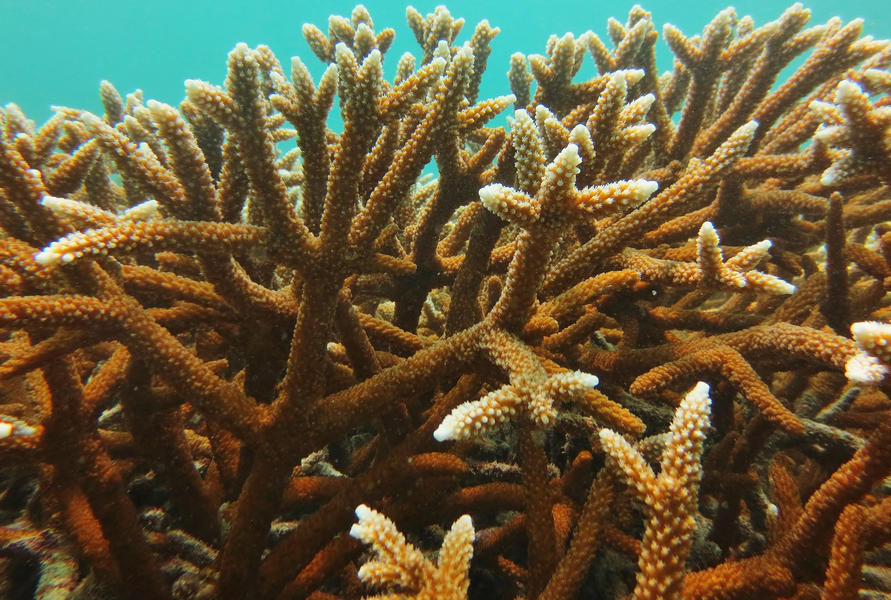
Advancing Coral Reef Research and Resilience in Southeast Florida: Phase 6

This project applied multiple approaches to help understand, reduce, and mitigate coral reef declines in Florida. Continued monitoring of coral condition in the northern portion of Kristin Jacobs Coral Aquatic Preserve (KJCAP) was coupled with genetics to inform coral restoration, coral salinity and thermal stress experiments, and experimental restoration efforts.
Corals in the northern KJCAP areas displayed very little bleaching or signs of disease in 2025-2026.
We’ve discovered several cryptic lineages across multiple species. Genetic diversity was higher in Florida as compared to Flower Garden Banks , highlighting the importance of species- and region-specific assessments of population connectivity for management and restoration planning.
Acute hyposalinity <20 Practical Salinity Units (PSU) resulted in coral mortality in KJCAP corals, and intermediate salinity stress (~25 PSU) significantly reduced corals’ recovery. Survival and recovery of corals can be improved by reducing freshwater discharges, and coral restoration outplanting should be avoided whenever salinity is <25 PSU.
Expanded coral restoration at St. Lucie Reef with transplants from Osborne tire reef maintained >80% survival after two years. For S. intersepta and Siderastrea siderea, larger transplant colonies had significantly greater survival probability. However, fragment size had no impact on the highly successful M. cavernosa transplants.
Resampling Restoration Team Trials corals after ~ 2 years and following the 2023 bleaching event revealed higher than expected survivorship, particularly in KJCAP, and strong evidence of adaptive bleaching in Biscayne and FKNMS.
Acute thermal bleaching among M. cavernosa in KJCAP occurs near 4 Degree Heating Weeks (DHW), with marginally increased resilience under chronic thermal stress. These data allow better bleaching predictions in KJCAP based on thermal stress and accumulated DHW.
Through DEP support, we have produced 25 peer-reviewed publications with 5 more in review. DEP support has contributed to 14 graduate degrees, several of whom now serve in state and federal agencies.