

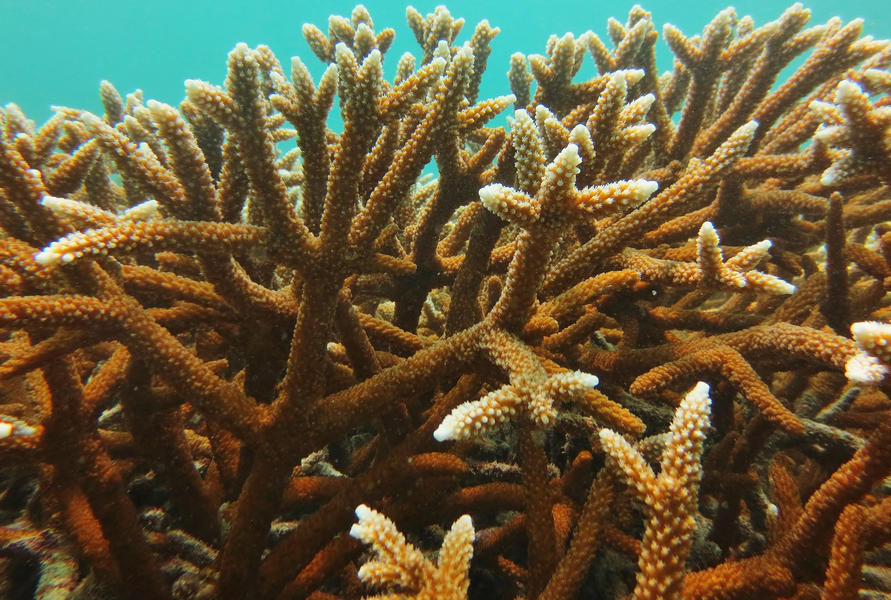
Polycentric governance for reef resilience: A case study of Florida’s Coral Reef Resilience Program

Here we report results from the first phase of a multi-year project that will evaluate and strengthen adaptive reef governance through Florida’s Coral Reef Resilience Program. Our primary focus during Phase 1 (February 1, 2026-June 30, 2026) was drafting a literature review that synthesizes existing scholarship on coral reef governance globally to identify key findings, lessons learned, and knowledge gaps. The review provides an important foundation for our research and for coral reef management in Florida broadly by highlighting governance challenges and opportunities documented across reef systems worldwide, while also identifying areas where additional research is needed to support effective governance and management. Our findings are preliminary and remain in draft form; the review will be finalized in Phase 2.
The literature consistently shows that coral reef governance is multi-level in nature, involving diverse actors, institutions, and decision-making authorities across scales. However, the presence of governance arrangements does not necessarily translate into effective governance outcomes. Existing frameworks for emerging climate interventions and coral restoration are frequently found to be inadequate for their intended purposes. While governance systems often demonstrate the capacity to adapt incrementally to environmental change, they rarely achieve the structural transformations needed to address escalating threats. Across the literature, recurring challenges include scalar mismatches, limited institutional fit, and issues related to participation. At the same time, recommendations for improving coral reef governance tend to remain broad, offering limited guidance for implementation in specific contexts.
The literature captured in this review is geographically concentrated in Australia, the broader Indo-Pacific region, and, to a lesser extent, the United States. Research focused specifically on Florida's coral reefs is limited. Overall, the review suggests that our empirical study of coral reef governance in Florida is well positioned to address an important gap in the literature, generating insights that can inform management in Florida and advance broader scientific understanding of coral reef governance.
In the second phase of the project, we will:
• Finalize the literature review and data collection instruments.
• Collect data for our case study of Florida’s Coral Reef Resilience Program through semi-structured interviews, document review, and participant observation at relevant meetings and events.
• Process and analyze data.
• Convene a knowledge co-production technical meeting to share preliminary findings and gather input on how the research can best inform management, policy, and practice.