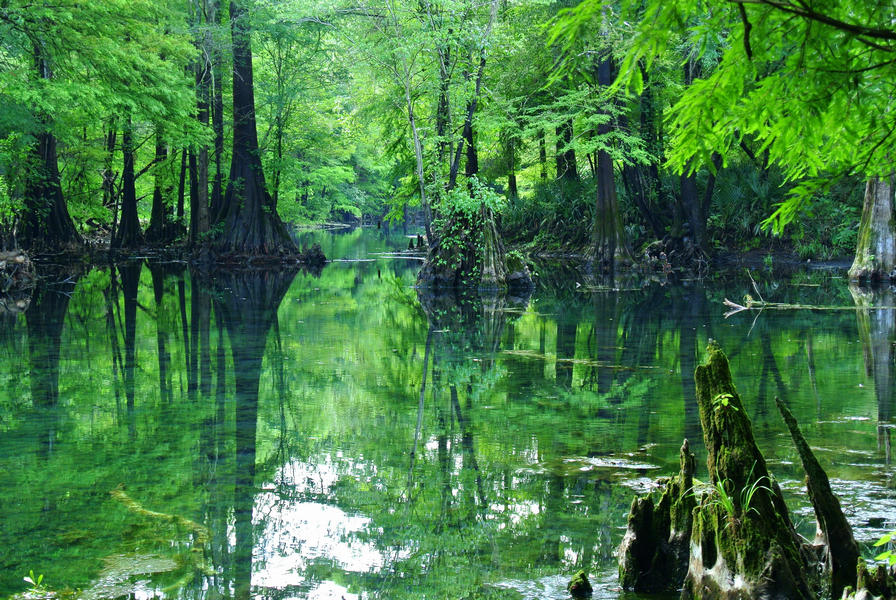
The Northern Everglades and Estuaries Protection Program (NEEPP; section 373.4595, F.S.) was established with the intent to protect and restore surface water resources to achieve water quality standards in the Northern Everglades through a phased, comprehensive and innovative protection program that includes long-term solutions to reduce nutrient loading to meet the state’s total maximum daily loads (TMDLs) established in accordance with section 403.067, F.S. The Northern Everglades watersheds include the Lake Okeechobee watershed and the Caloosahatchee and St. Lucie River watersheds and estuaries.
| Waterbodies | BMAP Documents | Contact |
|---|---|---|
St. Lucie River and Estuary
| Tony Tomalewski | |
Caloosahatchee River and Estuary
| Tony Tomalewski | |
Lake Okeechobee
|
| Chandler Keenan |
DEP has contracted Tetra Tech to update and develop Hydrological Simulation Program – FORTRAN (HSPF) models for all three watersheds in the Northern Everglades and Estuaries Protection Program. This effort will ensure one consistent modeling platform for the Northern Everglades BMAPs. The goal of this project is to prepare models that represents total nitrogen (TN) and total phosphorus (TP) loading throughout the watersheds to estimate the nutrient load reaching each of the target waterbodies. DEP will use the model results in future updates to the BMAPs.
| BMAP | Technical and Model Documents | Meeting Materials and Summaries |
|---|---|---|
| Caloosahatchee River and Estuary | Caloosahatchee Technical Meeting Materials (Aug 26, 2025) | |
| St. Lucie River and Estuary | ||
| Lake Okeechobee |
The content on the Florida Department of Environmental Protection's (DEP's) website was written and published in English, and English is the sole authoritative language for all such content. As an aid to site visitors who might benefit from multiple language options, the website offers an automated translation feature for browser content in the footer. The translation link will not convert attached or linked files, such as PDFs.
The website translation feature uses Gtranslate® (https://www.drupal.org/project/gtranslate). Gtranslate® is a third-party tool which is not owned, maintained, modified, or controlled in any way by DEP, and which is not endorsed by DEP as preferable to either human-generated translations, or any other automated translation options.
Translation is a nuanced and complex activity and computer-generated translations cannot be expected to be perfectly accurate. Automated translations of this site are not reviewed in advance by DEP and could convey incorrect or offensive language. DEP disclaims any liability for errors, omissions, or interpretive inconsistencies arising in the context of such translation. Site users assume all risk in using translated text. DEP is not responsible for any loss, damage, or harm resulting from reliance on translated text. Use of the translation tool in this website implies understanding and agreement with this assumption and disclaimer.