

Watershed Monitoring
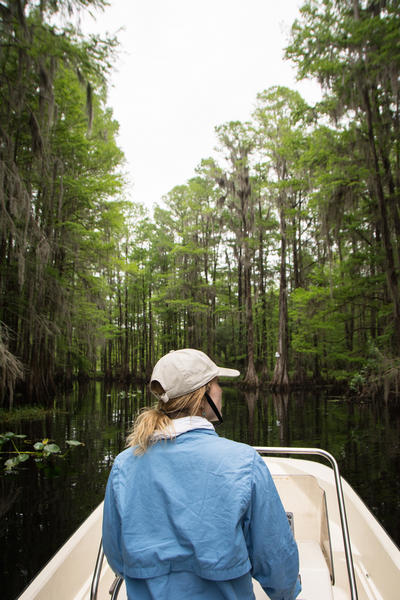
One of DEP’s top priorities is watershed and ecosystem restoration. The process begins with collecting reliable data. DEP’s Watershed Monitoring Section (WMS) fills this role by taking water samples from rivers, streams, lakes, canals and wells around the state.
Laboratory scientists measure the levels of certain “indicator” substances in each sample. Dissolved oxygen, nutrients and bacteria are examples of these water quality indicators. Other sections in DEP use these data to determine which waters are impaired and what should be done to restore them. The success of these plans is dependent upon accurate and representative data.
In 1996, DEP updated its water monitoring strategy to increase efficiency and save money. The program, called the Integrated Water Resource Monitoring Network (IWRM), monitors Florida’s water at three spatial scales or “tiers.”
- Tier I relates to the state as a whole.
- Tier II includes basin-scale monitoring to identify and confirm impaired waters.
- Tier III consists of site-specific monitoring to determine regulatory compliance.
Results from IWRM are used in the state’s Integrated 303(d) / 305(b) Report to the U.S. Environmental Protection Agency.
Several DEP and regional monitoring groups work together to achieve the goals of IWRM. The role of the WMP is to manage two programs in Tier I: the Status and Trend monitoring Networks. These programs have distinct but complementary goals. Briefly, the Status Monitoring Network provides a snapshot of Florida’s current water quality; the Trend Monitoring Network measures changes over time.
The WMS developed a new design for these networks in 2009, and made some minor revisions in 2012. View the latest Design Document for more information.
Along with participation in IWRM, the WMP staff leads the Florida Water Resources Monitoring Council. The Council aims to enhance communication among monitoring groups to reduce duplication of efforts and to coordinate fresh and marine monitoring programs.
Please browse the links at left for more information on Watershed Monitoring's programs, reports and data. For additional assistance, call us at 850-245-8080.