

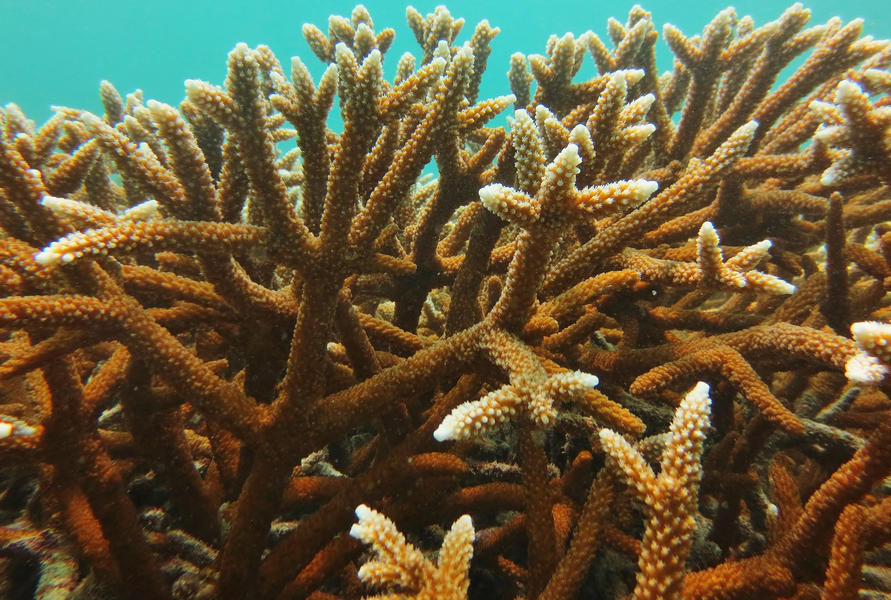
Coral Propagation: Land-based and Offshore Nursery Phase V

Nova Southeastern University’s ex situ and in situ nurseries have successfully spawned, reared and settled larvae, grew out juveniles, and outplanted corals of many priority species in the Coral ECA. At our facility in 2023, seventeen Montastraea cavernosa colonies, eight Pseudodiploria clivosa colonies, three P. strigosa colonies, five Orbicella faveolata and, for the first time ever, two colonies of Colpyhilla natans spawned. Uniquely, C. natans spawned after the October full moon, this was the first time NSU has spawned and larval reared C. natans from corals originating in the Coral ECA.
We have found that, to successfully hold and induce synchronous spawn corals it is best to keep corals in monocultures, i.e., all the colonies within a tank should be of the same species. This allows us to precisely control the aquarium lighting, filtration equipment, and automatic dosers, to meet the species-specific requirements of that species, such as water quality parameters, nutrient N:P ratios, and lighting. The spawning synchrony of M. cavernosa was moderately high. While M. cavernosa is found to spawn over a few days, more than half the colonies (11) spawned on the tenth day after the full moon. We found more frequent feeding (three to four times a week), led to a balanced sex ratio in M. cavernosa (10 female to 7 male), which was a considerable improvement relative to the a year prior (4 female to 1 male). Unfortunately fertilization was unsuccessful. We believe this was due to the reuse of pipettes which had been cleaned but likely still contained bleach residues that impaired sperm motility; from now on, we will always use single use pipettes to collect sperm.
While approximately 1000 corals reached the size for outplanting, these are likely just 1-2% of the larvae we settled, i.e. post-settlement mortality remains high which suggests there is still a lot room from optimization. Most of the mortality occurs within the first month after settlement and we think this is because the density at settlement is very high. Corals tend to settle in close proximity. If one dies, the likelihood of the close corals to die tends to be very high likely due to a combination of competition but also increase in bacterial community when a death occurs. To prevent this, we recommend the increase in settlement area per number of larvae to settle. This however requires a much larger space for settlement, and then for grow-out. We are currently expanding our grow-out area to maximize survival post-settlement. Growth rates of corals at the ex situ nursery have increased substantially in the past years, and we believe are now similar if not even better than the growth rates of coral recruits in situ.