

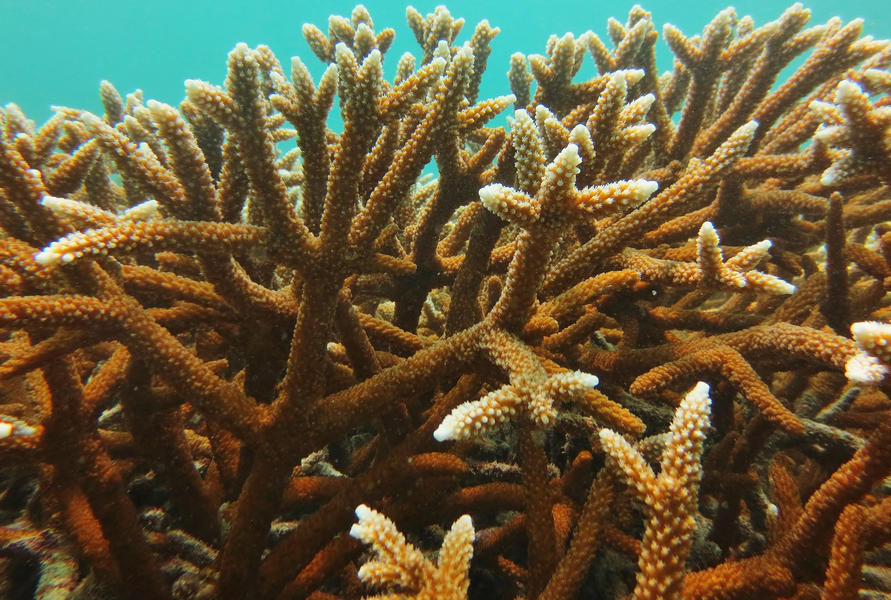
Defining suspended sediment tolerance and warming thresholds for Caribbean Endangered Species Act (ESA) and/or Stony Coral Tissue Loss Disease (SCTLD) susceptible corals

Coral reefs play a vital role in marine tourism, food production, coastal protection, and as habitats for numerous marine species. With about half of the global population living near coastlines, monitoring and managing human impacts on these ecosystems, particularly turbidity from activities like dredging, is crucial. Elevated turbidity levels can significantly stress and reduce coral health, with specific thresholds varying by species and region. Research has shown that corals, such as those in the genus Orbicella, are highly sensitive to changes in water clarity. Turbidity levels above 10 NTU in Florida and 30-40 NTU in other regions have been linked to coral stress and mortality. The decline in Orbicella corals in the Caribbean, primarily due to bleaching and disease, is a critical concern. Managing local stressors like turbidity is essential for their recovery. The study aimed to: 1) identify suspended sediment thresholds for Orbicella faveolata under short-term exposure; 2) examine the combined effects of turbidity and temperature on its metabolism, health, and calcification; and 3) assess the interactions between turbidity and temperature. The methodology involved using fine-grain sediment from a dredge site in Port Everglades, Florida, and employing acute intermittent flow respirometry to expose O. faveolata to elevated turbidity and temperature independently and together across two phases for a 72-hour exposure. Measurements focused on metabolism, photosynthetic efficiency, calcification, and other biological responses. Findings indicated that 29 and 50 NTU turbidity levels significantly reduced O. faveolata oxygen production, mainly affecting photosynthesis during daylight. Elevated temperatures had a more dramatic effect on oxygen production and photosynthesis. No significant differences were observed in photosynthetic efficiency, though elevated temperatures showed negative trends. Visual trends in calcification indicated potential acclimation and stress responses over time, suggesting the need for longer exposure studies. Chlorophyll and protein concentrations were not significantly affected by turbidity or temperature, indicating slower response rates compared to photosynthesis and respiration. The study concluded that coral metabolism is highly sensitive to environmental stressors, making it a useful indicator for future studies. Other measured responses were not impacted by short-term (72h) exposure to fine-grain sediment, suggesting potential latent effects of treatment. Genotypic variation was observed across all treatments, highlighting the importance of considering genetic diversity in future research. For future studies, testing different types of sediment, specific to various sites and ports, is recommended to better understand the impacts on coral health. Assessing indirect impacts and conducting longer exposure periods ranging from 72 hours to 4 weeks will provide more comprehensive insights. Increasing genotype replication and including more coral species in the studies will enhance the understanding of species-specific and genotype-specific responses to environmental stressors. Defining biologically relevant turbidity benchmarks is essential for managing human activities and mitigating climate change impacts on coral reefs. This study underscores the importance of ongoing research and adaptive management strategies to protect and sustain coral reef ecosystems amidst growing environmental pressures.