How to become a Florida Licensed Professional Geologist
There are two pathways one can take to become a Florida Licensed Professional Geologist.
- Licensure through testing and work experience
- Licensure through endorsement
Both pathways require passing both portions of the Association of State Boards of Geology (ASBOG) exams. Exam and license eligibility are regulated by the Florida Department of Business and Professional Regulation (DBPR) and the Florida Board of Professional Geologists (BOPG). There are two exams, the Fundamentals of Geology (FG) exam and the Practice of Geology (PG) exam. Exams other than the ASBOG exams are allowed if the other exam(s) is equivalent to or more stringent than the ASBOG exams. A list of those accepted exams is online. There are 32 states that administer the ASBOG exams as part of the process of becoming a licensed professional geologist. Licenses attained in an ASBOG state are reciprocal between states. Each state has its own set of regulatory rules governing professional geologist licensure and license reciprocity.
The ASBOG FG and PG exams are administered twice a year, nationwide in March and October.
All application forms are found on DBPR’s BOPG webpage under the Getting Started in Geology, Apply For a License section. Each application type requires a fee, and the fees vary depending upon which method applies to gain licensure through. All application forms are submitted to the DBPR either electronically through the DBPR Online Services website or by mail using a printable application form. Official transcripts, if required by the method by which one is seeking to gain licensure by, must be transferred from the education institution directly to DBPR.
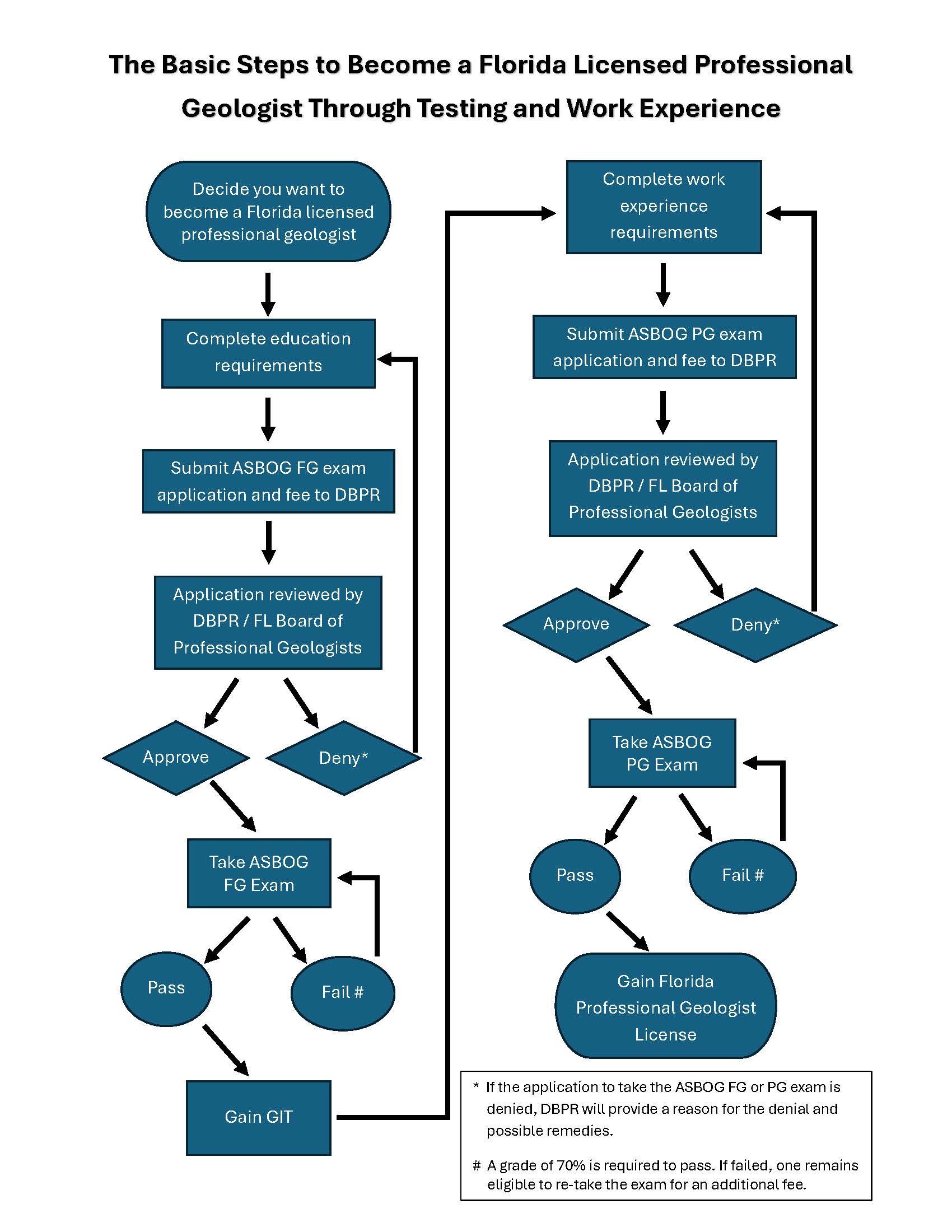
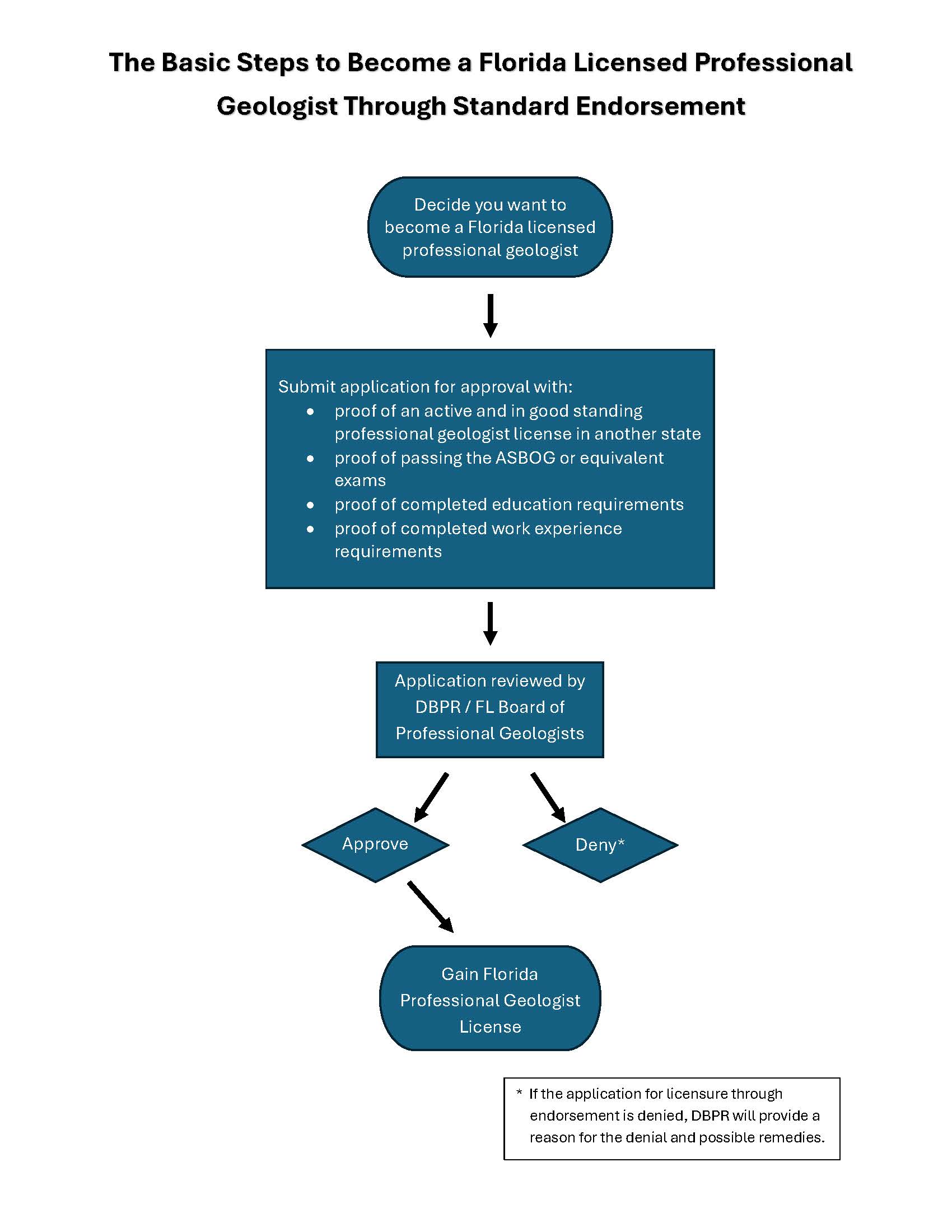
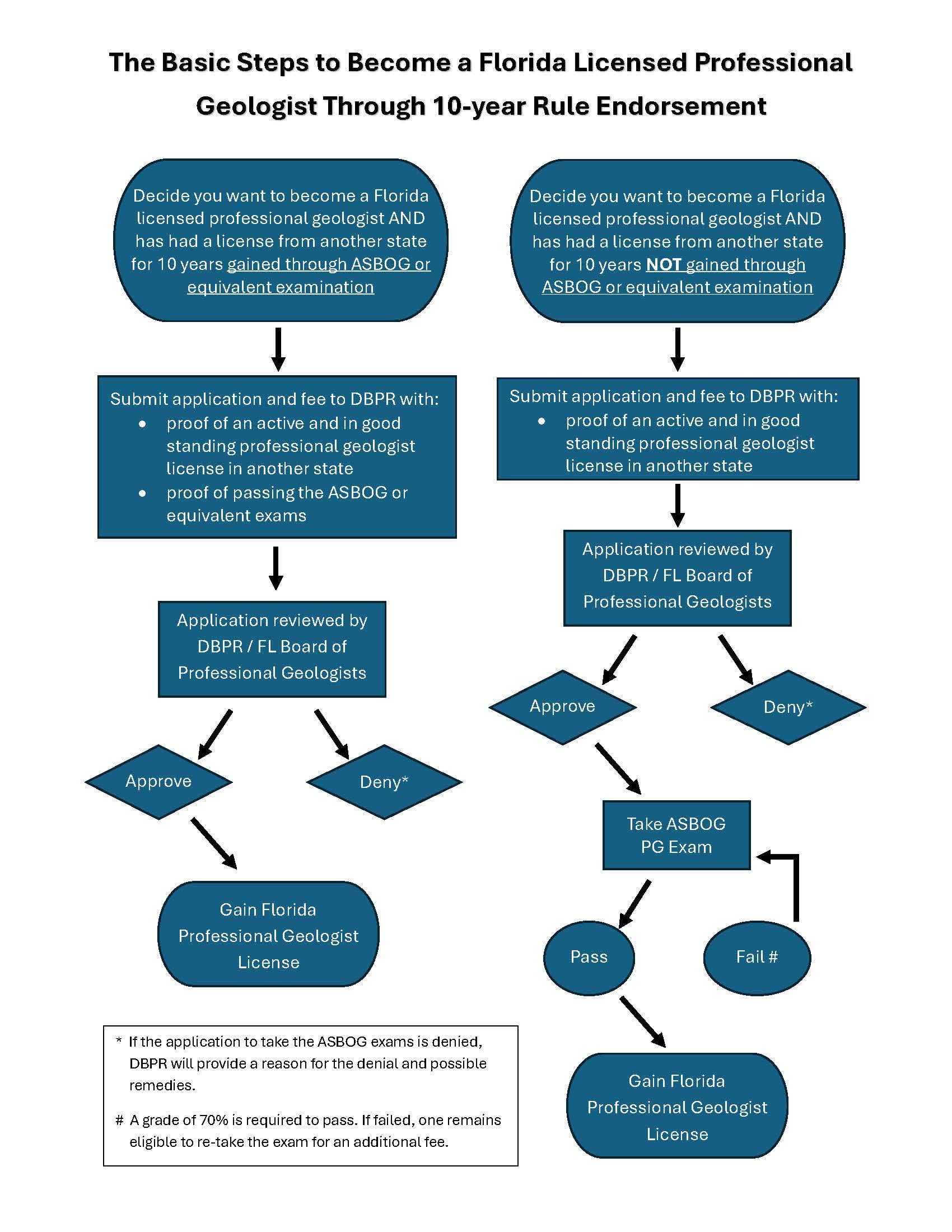
The basic process steps to gain licensure are presented below and in the accompanying process charts found at the bottom of this webpage.
Licensure through testing and work experience
To be eligible to take the FG exam a candidate must graduate from an accredited college or university with a degree in geology or another related field and must provide proof through submission of official transcripts they have completed a minimum of 30 semester hours, or 45 quarter hours, of acceptable geology coursework. Examples of acceptable geological courses can be found in Chapter 61G16-5, Education and Experience Requirements, Florida Administrative Code. A candidate can apply to take the FG exam as soon as they meet the education requirements. Once a candidate passes the FG exam, they become certified as a Geologist-in-Training (GIT). GIT certification gained in another ASBOG state through having passed the FG exam is reciprocal with Florida.
However, taking the FG exam immediately after meeting the education requirements is not required. A candidate can choose to take the FG and PG exams together, but only if they meet the eligibility requirements to take the PG exam.
To be eligible to take the PG exam, a candidate must gain five years of verified geological work experience. Three of those five years must be supervised by a licensed Florida professional geologist or a licensed Florida professional engineer who is qualified to sign-off on geological work experience (e.g., electrical, chemical, nuclear, computer, or aeronautical engineers are unlikely to be qualified to sign-off on geological work experience).
Once a candidate has passed the FG and PG exams, they then become a licensed Florida professional geologist, and a license number is issued by DBPR.
Licensure through endorsement
Candidates who hold a professional geologist license in another state may be eligible to gain licensure in Florida through endorsement. There are two ways to gain licensure through endorsement, standard endorsement or endorsement through the 10-year rule.
Standard Endorsement
For standard endorsement a candidate must:
- Provide proof of an active and in good standing professional geologist licensure in another state
- Provide proof they passed the ASBOG FG and PG exams or an exam(s) equivalent to or more stringent than the ASBOG exams
- Submit official transcripts proving they have completed a minimum of 30 semester hours, or 45 quarter hours, of acceptable geology coursework
- Provide proof they have completed five years of verified geological work experience with a minimum of three years endorsed by a licensed Florida professional geologist or a licensed Florida professional engineer who is qualified to sign-off on geological work experience
10-year Rule Endorsement
For 10-year rule endorsement a candidate must:
- Provide proof of an active and in good standing professional geologist licensure in another state for a minimum of 10 years before the candidate’s application date
- Provide proof they passed the ASBOG FG and PG exams or an exam(s) equivalent to or more stringent than the ASBOG exams
- If the candidate holds an active and in good standing professional geologist license from another state, but the license was not obtained through examination, the candidate will then become immediately eligible to take the ASBOG FG and PG exams. Once they have passed those exams they will be issued a Florida professional geologist license.
This document presents a condensed synopsis of the requirements and process needed to gain a Florida professional geologist license. Professional geologists are a regulated profession, and as such there are state rules and regulations governing all these aspects presented herein and do not account for every possible scenario. For a complete listing of the rules and regulations governing Florida professional geologists and licensure, visit the Florida Department of Business and Professional Regulation’s Florida Board of Professional Geologists website.
Role of the Florida Board of Professional Geologists
The Florida BOPG reviews all applications to take either the FG or PG (or both) exams or to gain licensure through endorsement. The board will either approve or deny a candidate’s application. DBPR will then inform the candidate of the board’s decision and provide feedback. If an application is denied, DBPR will suggest actions the candidate can take to gain possible future approval.
BOPG meets four times a year, typically January, April, July, and October, to review applications for approval or denial. Additionally, if any disciplinary issues arise involving a licensed professional geologist or an individual or company is accused of illegally conducting geological work without a license, among other things. It is recommended that candidates attend the BOPG meeting when their application is being reviewed. If an issue arises that needs further clarification, the candidate can provide that information and possibly avoid delays in the application process.
Licensure Process Charts