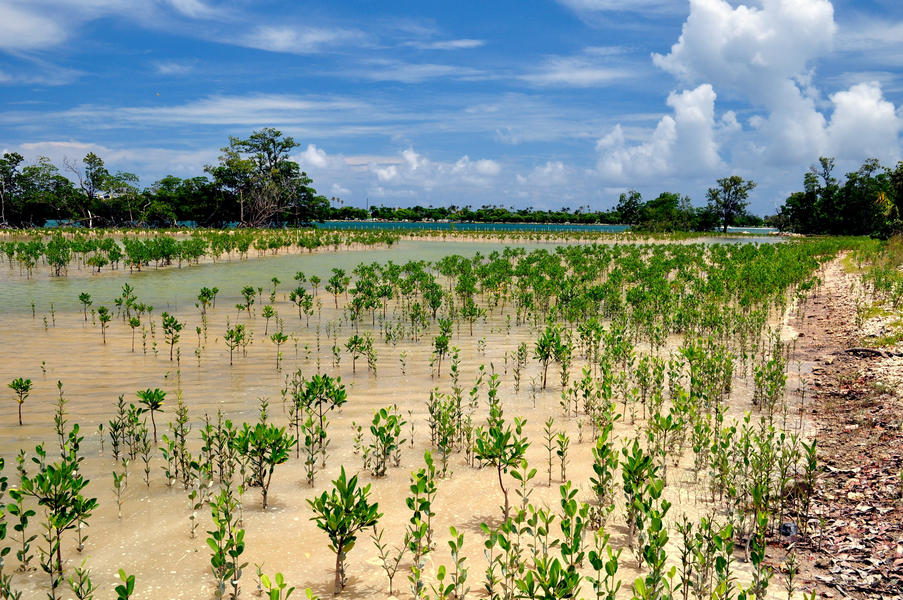
For many decades Florida has had a narrative nutrient water quality criterion in place to protect Florida’s waters against nutrient over-enrichment. In 2009, the department initiated rulemaking and, by 2011, adopted what would be the first set of statewide numeric nutrient standards for Florida’s waters. By 2015, almost all of the remaining waters in Florida have numeric nutrient standards.
The vast majority of Florida’s freshwater streams, lakes and springs are covered by numeric interpretations of the nutrient criterion, and only wetlands (except for the Everglades Protection Area) and South Florida canals are not covered by numeric nutrient criteria. Non-perennial streams, man-made or physically altered canals/ditches with poor habitat used primarily as water conveyances for flood control, irrigation, etc., and tidal creeks may also be solely covered by the narrative criterion once properly documented as meeting one of the exclusions for the definition of a stream. The Florida coastline is separated into estuary and coastal segments. Numeric nutrient criteria are established for all estuary segments, including criteria for total nitrogen, total phosphorus, and chlorophyll a. For open ocean coastal waters, numeric criteria are established for chlorophyll a that are derived from satellite remote sensing techniques.
Numeric Nutrient Standards
The department has developed a web-based geographic tool, NNC Tracker, that the public and environmental professionals can use to view the NNC applicable to waterbodies throughout Florida. NNC Tracker is available from the department’s portfolio of online interactive maps. After selecting the NNC Tracker, the user can click on an interactive map of Florida, select from among a variety of views and data layers, and locate a waterbody or area of interest to view information about the waterbody and the applicable nutrient criteria.
The content on the Florida Department of Environmental Protection's (DEP's) website was written and published in English, and English is the sole authoritative language for all such content. As an aid to site visitors who might benefit from multiple language options, the website offers an automated translation feature for browser content in the footer. The translation link will not convert attached or linked files, such as PDFs.
The website translation feature uses Gtranslate® (https://www.drupal.org/project/gtranslate). Gtranslate® is a third-party tool which is not owned, maintained, modified, or controlled in any way by DEP, and which is not endorsed by DEP as preferable to either human-generated translations, or any other automated translation options.
Translation is a nuanced and complex activity and computer-generated translations cannot be expected to be perfectly accurate. Automated translations of this site are not reviewed in advance by DEP and could convey incorrect or offensive language. DEP disclaims any liability for errors, omissions, or interpretive inconsistencies arising in the context of such translation. Site users assume all risk in using translated text. DEP is not responsible for any loss, damage, or harm resulting from reliance on translated text. Use of the translation tool in this website implies understanding and agreement with this assumption and disclaimer.