

Project GreenShores
Aquatic-Preserve Quick links
- Alligator Harbor Aquatic Preserve
- Apalachicola Bay Aquatic Preserve
- Banana River Aquatic Preserve
- Big Bend Seagrasses Aquatic Preserve
- Biscayne Bay Aquatic Preserves
- Boca Ciega Bay Aquatic Preserve
- Cape Haze Aquatic Preserve
- Cape Romano-Ten Thousand Islands Aquatic Preserve
- Cockroach Bay Aquatic Preserve
- Coupon Bight Aquatic Preserve
- Estero Bay Aquatic Preserve
- Fort Pickens Aquatic Preserve
- Gasparilla Sound-Charlotte Harbor Aquatic Preserve
- Guana River Marsh Aquatic Preserve
- Indian River-Malabar to Vero Beach Aquatic Preserve
- Indian River-Vero Beach to Fort Pierce Aquatic Preserve
- Jensen Beach to Jupiter Inlet Aquatic Preserve
- Kristin Jacobs Coral Aquatic Preserve
- Lake Jackson Aquatic Preserve
- Lemon Bay Aquatic Preserve
- Lignumvitae Key Aquatic Preserve
- Loxahatchee River-Lake Worth Creek Aquatic Preserve
- Matlacha Pass Aquatic Preserve
- Mosquito Lagoon Aquatic Preserve
- Nassau River-St. Johns River Marshes and Fort Clinch Aquatic Preserves
- Nature Coast Aquatic Preserve
- North Fork, St. Lucie Aquatic Preserve
- Oklawaha River Aquatic Preserve
- Pellicer Creek Aquatic Preserve
- Pine Island Sound Aquatic Preserve
- Pinellas County Aquatic Preserves
- Rainbow Springs Aquatic Preserve
- Rocky Bayou Aquatic Preserve
- Rookery Bay Aquatic Preserve
- St. Andrews Aquatic Preserve
- St. Joseph Bay Aquatic Preserve
- St. Martins Marsh Aquatic Preserve
- Terra Ceia Aquatic Preserve
- Tomoka Marsh Aquatic Preserve
- Wekiva River Aquatic Preserve
- Yellow River Marsh Aquatic Preserve
- All Aquatic-Preserve content
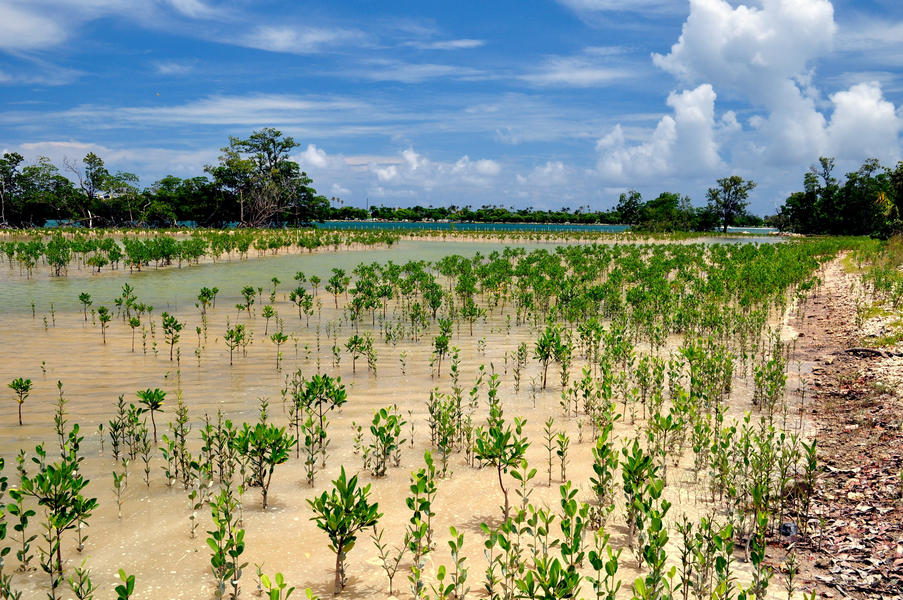
Project GreenShores is a multimillion dollar habitat restoration and creation project in downtown Pensacola along the urban shoreline of Pensacola Bay. This habitat restoration effort partners DEP's Northwest Florida Aquatic Preserves with the city of Pensacola, Escambia County, the Ecosystem Restoration Support Organization, the EPA Gulf of Mexico Program, the National Fish and Wildlife Foundation, the U.S. Fish and Wildlife Service, NOAA, Gulf Power, local agencies, businesses and volunteers in a community-based effort to restore oyster reef, salt marsh and seagrass habitat within the Pensacola Bay System. Restoring the Pensacola Bay estuary to its historic state stabilizes shorelines and provides essential habitat for wildlife propagation and conservation.
Project GreenShores was constructed in phases and consists of two adjacent sites in Pensacola Bay. Site 1 was completed in 2003 and consists of 15 acres of estuarine habitat composed of seven acres of oyster reef and eight acres of salt marsh/seagrass habitat. Site 1 has received several awards including the 2003 Coastal America Partnership Award, the 2004 EPA Gulf of Mexico Program’s Gulf Guardian Award and the Conservation Award from the Francis M. Weston Audubon Society in 2007.
In 2003, the first phase at Site 1 of Project GreenShores was completed with minimal replantings in the summer of 2004. Seven acres of constructed oyster reef consists of 14,000 tons of Kentucky limestone, 6,000 tons of recycled concrete and 40 wave attenuators. The eight-acre salt marsh incorporated 35,000 cubic yards of sand and 40,000 smooth cordgrass (Sporobulus alterniflorus plants. Project GreenShores Site 2, constructed in the summer of 2007, encompasses the area of Pensacola Bay from the western shore of Muscogee Wharf up to and including Hawkshaw Lagoon. This site consists of two submerged breakwaters of approximately 600’ x 150’x 0.5’ (below Mean Low-Water line) which were constructed using 25,000 cubic yards of recycled concrete obtained from a decommissioned airfield at NAS Pensacola. The submerged breakwaters will function to reduce fetch-driven wave energy before it reaches the intertidal marsh islands and shoreline. In time, the breakwaters will also serve as a living oyster reef as oyster larvae settle and grow on the substrate provided. Three intertidal marsh islands were constructed using 16,000 cubic yards of spoil material from a previous dredge of the Escambia River.
The islands were planted with 30,000 smooth cordgrass, grown at the DEP Nursery facility, during a substantial community volunteer effort with the help of local Boy Scout, Cub Scout and Girl Scout troops as well as numerous individuals and civic groups in September of 2007. Additional breakwater and salt marsh areas was constructed in the next few years under NRDA funding.
For more information, contact Zach Schang.